Question
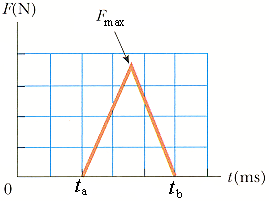
An estimated force-time curve for a baseball struck by a bat isshown in the figure below. Let
Fmax =20000 N,
ta =1 ms, and
tb =2.5 ms. Figure(
http://www.webassign.net/pse/p9-09alt.gif) From this curve, determine each of the following. (a) the impulse delivered to the ball
1 N·s
(b) the average force exerted on the ball
2 N
(c) the peak force exerted on the ball
3 N (a) the impulse delivered to the ball
1 N·s
(b) the average force exerted on the ball
2 N
(c) the peak force exerted on the ball
3 N
Explanation / Answer
a) The impulse is the integral of force with respect totime. So the impulse is the area between the curve and x-axis in thefigure you linked above. It's easy to calculated the area of the isoceles triangle inthe figure above. The area of the triangle= (1/2)*(the length of bottomedge)*(height of the triangle with respect to bottom edge) Here the length of bottom edge = time difference t =tb - ta = 2.5ms-1ms =1.5ms =1.5*10-3s, and the height of the triangle with respect to bottom edge =the maximum force Fmax =20000N, so the impulse = the area of the triangle =(1/2)*(1.5*10-3s)*(20000N)= 15Ns. b)(The average force) * (time difference t )= theimpulse so (Favg)*(1.5*10-3s)=15Ns, Favg=10000N. c)the peak force exerts on the ball equals the maximum force,which is 20000N.