The diagram below shows the positions at intervals of 0.05 seconds of two balls
ID: 2126463 • Letter: T
Question
The diagram below shows the positions at intervals of 0.05 seconds of two balls moving from left to right. Are either or both of these balls accelerated?
2. Two identical pieces of paper, one crumpled into a ball and the other left uncrumpled, are released simultaneously from the same height above the floor. Which one, if either, do you expect to reach the floor first? Explain.
The flat paper will reach the ground first because it will glide to the floor more quickly.Both will reach the ground at the same time because their downward accelerations are identical. The crumpled paper will reach the ground first because it will be less affected by air resistance.
3. A ball thrown straight upward moves initially with a decreasing upward velocity. What are the directions of the velocity and acceleration vectors during this part of the motion?
Does the acceleration also decrease? Explain.
A ball is dropped from a high building. Using the approximate value of g = 10 m/s2, find the change in velocity between the fourth and fifth second of its flight. m/s
5. A ball is thrown upward with an initial velocity of 15 m/s. Using the approximate value of g = 10 m/s2, what are the magnitude and direction of the ball's velocity at the following times?
(a) 0.95 s after it is thrown
m/s
(b) 2.10 s after it is thrown
m/s
6. A ball rolls off a shelf with a horizontal velocity of 5 m/s. At what horizontal distance from the shelf does the ball land if it takes 0.5 s to reach the floor?
m
7. A ball rolls off a platform that is 7 meters above the ground. The ball's horizontal velocity as it leaves the platform is 4.2 m/s.
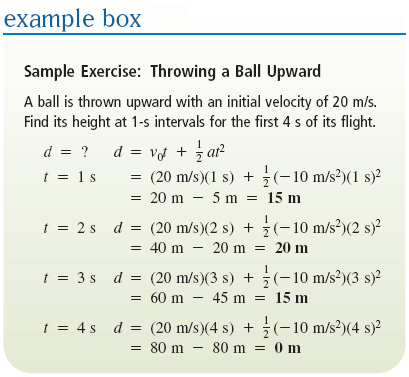
(a) How much time does it take for the ball to hit the ground? (See the example box, use g = 10 m/s2.)
s
(b) How far from the base of the platform does the ball hit the ground?
m
The diagram below shows the positions at intervals of 0.05 seconds of two balls moving from left to right. Are either or both of these balls accelerated?
Explanation / Answer
Number 1) Both balls are being accelerated
Number 2) The crumpled paper will reach the ground first because it will be less affected by air resistance.
Number 3) The direction of the velocity vector is upward and the direction of the acceleration vector is downward.
Number 4) No, the acceleration does not decrease but remains constant.
Number 5)
At .95 sec
vf = vo + at
vf = 15 + (-10)(.95)
vf = 5.5 m/s upward
At 2.10 s
vf = 15 + (-10)(2.1)
vf = 6 m/s downward
Number 6)
d = vt
d = (5)(.5) = 2.5 m
Number 7)
Apply d = vot + .5at^2
7 = 0 + (.5)(10)(t^2)
t = 1.18 sec
d = vt
d = (4.2)(1.18) = 4.97 m