Picture: http://www.webassign.net/serpse8/8-p-027.gif A child of mass m starts f
ID: 2191510 • Letter: P
Question
Picture:http://www.webassign.net/serpse8/8-p-027.gif
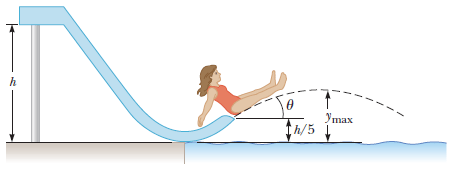
A child of mass m starts from rest and slides without friction from a height h along a slide next to a pool (see figure). She is launched from a height h/5 into the air over the pool. We wish to find the maximum height she reaches above the water in her projectile motion.
Express the total energy of the system when the child is at the highest point in her projectile motion. (Use any variable or symbol stated above along with the following as necessary:g,vxfor her speed at maximum height, andymfor her maximum airborne height.)
(g) From parts (d), (e), and (f), determine her maximum airborne heightymaxin terms ofhand the launch angle?. (Use any variable or symbol stated above as necessary.)
Explanation / Answer
The kid starts with total energy TE = GPE = mgh and loses mgh - mgh/5 = 1/2 mU^2 = KE.
The lost potential energy is 100% converted into kinetic energy at h/5 because there is no friction loss.
Total energy at the lip of the slide is TE = 1/2 mU^2 + mgh/5 = KE + pe = mgh = TE
Thus U = sqrt(4gh/5) = vi ANS. This is the kid's initial speed off the slide.
Max height above h/5 is Y = Uy^2/2g = (U sin(theta))^2/2g = (4gh/5) sin(theta)^2/2g = 4h/10 sin(theta)^2 = (2/5)h sin(theta)^2 ANS.
Note: This presumes that h/5 is at the same elevation as the surface of the pool water. If there is a distance between h/5 and the pool's surface, that difference has to be added in.